
5 Ways Any Basketball Player Can Earn More Playing Time
You say you want more playing time.
You say you want more playing time.
Good.
Now the real question: Do your daily habits prove it? Because coaches don’t give minutes.
They loan them…
…to the players they trust most.
Here are 5 guaranteed ways to earn more playing time that most average players never take seriously. If you’ll actually do these, consistently, you will make it very hard for your coach to keep you on the bench.
1. Leave Excuses to the Losers
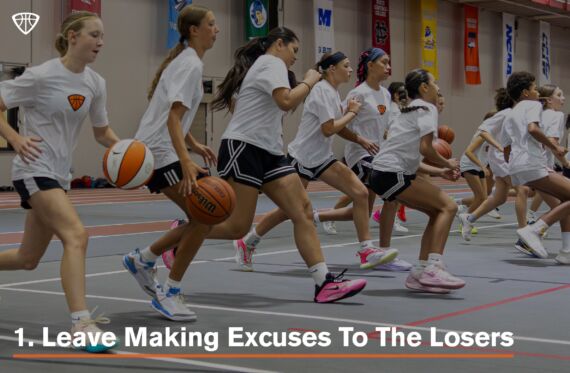
“Nearly all mediocre players are great at finding reasons, excuses, and alibis for their failures.” – Dick DeVenzio
You can’t be a “more playing time” player and an “excuse” player at the same time. Pick one.
Every season, coaches get the same questions:
“Coach, what do I need to do to play more?”
“Coach, why is he playing over me?”
The better question is the one you should be asking yourself first:
Am I giving maximum effort in every practice, every drill, every sprint, every game?
Do I compete in the film room, or just sit there and zone out?
If the honest answer is anything less than “yes,” then stop.
Don’t blame the coach. Don’t blame your teammates. Don’t blame the system.
Start with you.
A few ultra-practical “no-excuse” moves:
- Star in your role.
- “Coach, what exactly is my role on this team?”
- “What are the 1–2 things you need me to do to help us win?”
Ask your coach:
Then go become elite at those 1–2 things… before you worry about expanding your role.
- Control the controllables.
You can’t control the refs. You can’t control who your coach started last year. You can control your effort, your attitude, your body language, your preparation, and your response to adversity.
- See a need, fill a need.
Your team struggles to rebound? Then your new job is to become the best rebounder in the gym.
Your team can’t guard the other team’s star? Volunteer to be that matchup and take pride in making their night miserable.
“Average players are experts at telling stories about why they’re not playing. Serious players are too busy fixing problems to complain about them.”
2. Become a Maniacal Student of the Game

Want more playing time? Get smarter. Basketball IQ is a performance enhancer.
Coaches love players who:
- Make the right read.
- Protect the ball.
- Understand time, score, matchups, and momentum.
- Are always one step ahead of the offense or defense.
That doesn’t come from scrolling highlight mixes. It comes from studying the game like a serious student.
A few ways to build your IQ:
a) Watch film differently than everyone else.
Most players watch film like this:
- “Let me find my highlights so I can make an Instagram reel.”
Serious players watch film like this:
- “Where did I break down?”
- “What patterns do I see?”
- “What are my habits — good and bad?”
Go back and chart something specific:
- Every time you got a paint touch: What happened?
- Every turnover: What exactly led to it?
- Every ball screen: Did you make the correct read?
Don’t just re-watch the makes. Sit in your mistakes and learn from them.
b) Build your anticipation.
Pick a game on film and try this:
- Pause right before a big moment (drive, ball screen, rotation).
- Ask: “What should happen next?”
- Then hit play and see if you were right.
Do this over and over:
- What coverage are they in?
- Where is the help coming from?
- Where should the ball go?
You’re training your brain to “see it before it happens.” That’s what great players do.
c) Learn what your coach considers a “great shot.”
Ask: “Coach, what are the 3 shots we’re hunting in our offense?”
Then shape your game around creating those shots for yourself and teammates.
When you become the player who:
- Understands the system,
- Plays within the system,
- And makes everyone else’s job easier…
…you become very difficult to sit.
3. Stop Being Satisfied & Never Disappear

Good players have moments.
Great players have impact — night in and night out.
You know the player:
Big first quarter. Hits a couple threes. Crowd’s into it. Bench is hyped.
Second quarter? Quiet.
Third? Invisible.
Fourth? You forget they’re even on the floor.
You cannot disappear and expect more minutes.
Consistent Aggression
Consistent aggression doesn’t mean forcing shots. It means:
- You’re always in attack mode — offensively and defensively.
- If you’re not scoring, you’re:
- Cutting hard,
- Screening hard,
- Sprinting the floor,
- Crashing the glass,
- Taking on tough defensive assignments,
- Talking, leading, directing.
If the only way you can impact a game is “when you’re scoring,” you’re a liability. Smart coaches will double you and turn you into a ghost.
Have Plan A, B, C, and D:
- A: Score when it’s a good shot.
- B: Create advantages for others (paint touches, kick-outs, extra passes).
- C: Be a defensive problem (ball pressure, gap help, rotations, rebounds).
- D: Own the hustle category (loose balls, 50/50s, sprinting back, taking charges).
Get in ridiculously good basketball shape
Here’s the truth almost nobody wants to hear:
You might see the game at a high level… but if you’re gasping for air after three trips, it doesn’t matter.
- Sprint in practice when everyone else is jogging.
- Run the floor every single possession.
- After practice, grab a teammate and play 1-on-1 full court.
- Push yourself past “comfortable tired” into “game tired.”
Conditioning isn’t sexy. But coaches trust the players who never get tired of doing the right thing.
4. Forget Your Stats. Obsess Over ‘Little Things’.
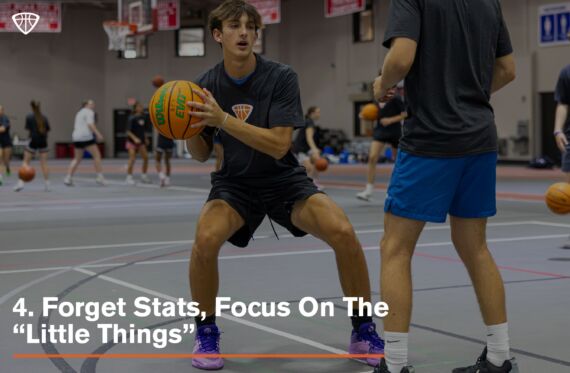
Most players worship the “Big 3”:
- Points
- Rebounds
- Assists
Coaches watch a different box score in their head:
- Perfect closeouts
- Gap help and stunts
- Talking on defense
- Screen assists
- Extra passes (hockey assists)
- Taking charges
- Sprinting back and preventing layups
- First to the floor on loose balls
Here’s the harsh reality:
There are players who score 18 points and hurt their team.
There are players who score 2 points and are the reason their team wins.
Which one are you?
Do the invisible work
A few “little things” that big-time coaches notice:
- Screen like you mean it – Free your teammate for a layup or three. That’s your bucket too.
- Win closeouts – Short, choppy steps. High hands. No blow-bys.
- Own the talk – Call out ball screens, switches, cutters.
- Sprint in transition – both ways.
- A layup for your team…
- Or a layup for theirs.
One hard sprint can be the difference between:
- Celebrate your teammates’ dirty work: – Start looking for the unseen plays in film and games:
- The help-side defender who stopped a drive.
- The teammate who dove on the floor.
- The player who rotated early and forced a bad shot.
- Point those out. Clap for them. Say, “I see you.”
You’ll raise the standard for your whole team and your coach will see you as a leader.
Stats may get posted on Instagram. Winning plays get you on the floor.
5. Train According to Your Aspirations
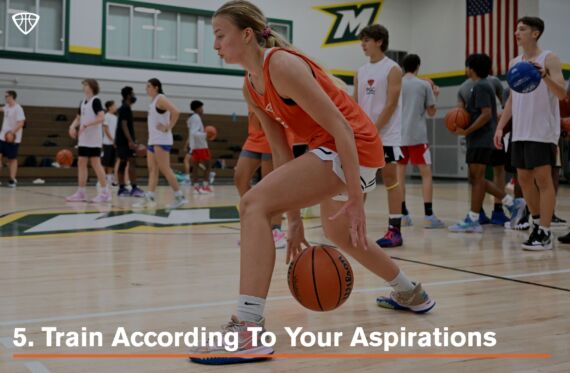
Everybody says they want to play more but very few players are willing to train like their dreams are actually real.
Want to separate yourself? Here’s a simple equation:
Price of Admission = Pre-practice + Post-practice work.
You don’t need a 3-hour workout. You do need consistent, focused, boring work.
The 20-Minute Difference:
If your gym has a shooting machine (like “The Gun”), do the math:
- 20 minutes
- ~20 shots per minute
- That’s about 400 shots.
If you did that 10 minutes before practice and 10 minutes after or 20 minutes before practice…
…over 40 practices, that’s 8,000 extra shots in a season.
Most players?
- Joke with teammates,
- Flip up a few lazy shots,
- Wait for practice to start.
Serious players?
- Show up early,
- Have a plan,
- Track their work,
- Stay after even when nobody is watching.
Fall in love with the boring stuff.
PGC founder, Dick DeVenzio, talked endlessly about mastering the fundamentals and refusing to be ordinary.
That doesn’t happen in big, dramatic moments. It happens here:
- Practicing the same footwork, over and over.
- Practicing the same finishes, over and over.
- Practicing the same form shots, over and over.
Not until you “get it right,” but until you can’t get it wrong.
You’ll need
- A simple written plan (not just “shoot around”).
- A commitment to stick to it no matter how you played last game.
- Great game? You still do your work.
- Terrible game? You still do your work.
Don’t let your emotions dictate your effort. Let your goals dictate your habits.
Final Word
If you walked into your coach’s office tomorrow and said,
“Coach, I want to earn more playing time,”
could you confidently say you’re already doing these five things?
- Owning everything and making zero excuses.
- Studying the game and building real basketball IQ.
- Competing with consistent aggression and great conditioning.
- Obsessing over winning plays, not just stats.
- Training with a clear plan before and after practice, day after day.
If not, you don’t need a speech.
You don’t need a new offense.
You don’t need your coach to “believe in you more.”
You need to go to work.
Start today.
If you actually live out these five, your only new problem will be this:
Your coach is going to have a hard time taking you off the floor.
If you want a done-for-you training plan, start a FREE 15-day trial of our newest online training platform called STAGES
Related Articles

5 Ways to Practice Mental Toughness
Here are five ways to practice your mental toughness off the court. If you practice these five things, every day, you’ll develop greater self-discipline. You’ll become unstoppable in anything you do. It is five things you will have to rise above your feelings every day. That is how you build mental toughness. You develop, as a habit, a muscle of rising above your feelings to level of your aspirations and commitments.

A Leadership Lesson Most Never Get
If there is one crucial concept that is important to living well, it’s learning to live between your own ears.

The 5 Life-Altering Journeys Players Go on During a PGC Basketball Camp
When your child attends a 5-day camp, they get around like-minded people all looking to improve at this thing they love called basketball.
About PGC
PGC Basketball provides intense, no-nonsense basketball training for players and coaches. Our basketball camps are designed to teach players of all positions to play smart basketball, be coaches on the court, and be leaders in practices, games and in everyday life.
We combine our unique PGC culture with a variety of teaching methods and learning environments to maximize the learning potential of those that attend our sessions. In addition to spending 6-7 hours on the court each day, lessons will be reinforced through classroom sessions and video analysis.
Our goal at PGC is to empower you with the tools to fulfill your basketball dreams, while also assisting you in experiencing the joy of the journey.
To learn more about PGC Basketball, including additional basketball training tips and videos, visit our YouTube Channel or find us on Facebook, Instagram, and Twitter.


Share This Post