
Basketball Shot Selection: The Key to Helping Your Team Score More Points
Every coach wants to score more points.
The question isn’t whether you want it. It’s whether you have a real plan for it.
Too often, offensive struggles get blamed on everything except the real issue. We say we need a better set. We say we need better play calls. We say we need more confidence. Sometimes that’s true. But most of the time, the path to scoring more points is simpler than we make it.
It comes down to three things:
- Generating better shots
- Improving basketball shot selection
- Developing better shooters
If you miss any of these, your offense is going to hit a ceiling. You can generate great looks, but if your players don’t recognize them, that’s a problem. Your players can understand what a good shot is, but if they can’t make it, that’s a problem too.
Before we dive in, here are a few more offensive resources you may want to check out after this one:
- Why Shooting Success in Practice Doesn’t Transfer to Games
- 7-Spot ‘Hubie’ Basketball Shooting Drill to Build Rhythm & Confidence
- Floater, Pull Up And 3 Point Shot | Basketball Shooting Drill
And if you want the full conversation behind this post, make sure to listen to or watch the Hardwood Hustle episode that inspired this post.
1. Generate Better Shots First
The first key is shot generation.
You can’t score efficiently on a steady diet of average shots and then act surprised when your offense feels stuck.
As coaches, we have to get clear on the kinds of shots we want. Not in theory. Not on a whiteboard. In reality… What are we hunting?
For some teams, that may be catch-and-shoot threes off drive-and-kick action. For another, it may be paint touches, foul-line pressure, and finishes at the rim.
The point is this: clarity has to come before creativity.
A lot of coaches fall in love with an offense before they get honest about what that offense produces. But your system is only helping you if it consistently creates the shots your team can make.
That means you need to ask:
- What shots generally lead to efficient offense?
- What shots does our team make well?
- What actions create those shots most consistently?
This is where data helps.
Instead of saying, “I think we’re good from there,” you can know. Instead of assuming a certain action is working, you can study what it’s producing. That changes how you script practice, what you emphasize in film, and what you reward in games.
And this is one of those areas where a lot of us could simplify things… The more clearly you can see what your team is generating, the easier it is to coach it. You can chart it by hand, you can study film, or you can use something like Noah to help track patterns. One way or another, you need to know.
Because once you know where your players are at their best, you can start building actions that get them there more often. And when your offense produces the shots your players are built to make, scoring gets easier.
2. Define Basketball Shot Selection So There’s No Gray Area
Once you know what shots you want to create, the next challenge is getting players to choose them.
This is where a lot of offenses break down.
The coach thinks one thing is a good shot. The player thinks something else. That’s how gray area creeps in, and gray area kills offensive efficiency.
Good teams eliminate that gray.
Your players need to know:
- What is a great shot for our team?
- What is a decent shot we can live with?
- What is a shot we need to turn down?
One of the simplest ways to teach this is with a shot-value system. Think in terms of something like 9s, 7s, 5s, and 3s.
A 9 is a gimme.
A 7 is the shot you want to hunt.
A 5 is one you can live with late in a possession.
A 3 is the bailout shot you settle for when nothing else is available.
That gives players a shared language. More importantly, it gives you a shared standard.
Now your feedback becomes clearer:
“That was a 5. We’re hunting 7s.”
“That’s not your shot yet.”
“That’s a 7 for him, but not for you.”
“That possession produced what we wanted, even though it missed.”
That last one matters.
Players need to understand that a good possession isn’t always judged by whether the ball went in. It’s judged by whether the team generated and selected the right shot.
This is also where players need to know their scoring spots.
Every player should know:
- where they shoot it well
- where they’re still growing
- where they need to move it, drive it, or create something better
That doesn’t limit players. It gives them a development roadmap. A player hearing “that’s not your shot yet” isn’t criticism. It’s clarity.
And that is where buy-in gets better.
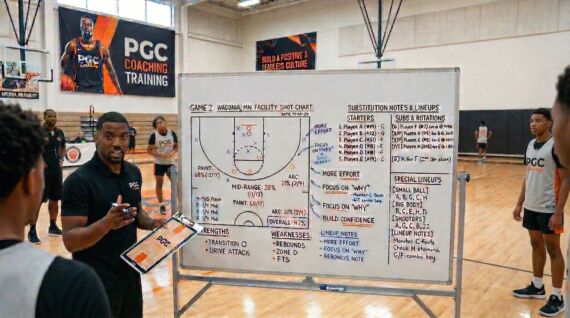
When players can see what you’re talking about, the conversation gets easier. Sometimes that comes from film. Sometimes it comes from a simple chart. Sometimes it comes from using a tool like Noah to show them trends by spot.
That is what good offensive coaching does.
3. Develop Better Shooters So the Plan Actually Works
The third key is simple to say and hard to ignore:
At some point, your players have to make shots.
You can generate clean looks. You can improve basketball shot selection. But if your team isn’t capable of converting those opportunities, offense still gets stuck.
That’s why player development has to stay in the conversation.
The mistake a lot of coaches make is thinking more reps automatically means more improvement.
Not true.
Players don’t just need more shots. They need better feedback, clearer targets, and reps that have purpose.
Beyond mechanics, players need to know why they’re missing.
Are they short consistently?
Are they spraying the ball left and right?
Are they taking shots they can’t control yet?
Are they practicing makes, or are they just collecting attempts?
That is a big difference.
A workout isn’t productive just because the gym was full and the ball was flying. A workout is productive when the player leaves better than they walked in.
Most players are willing to work. The challenge is helping them understand what to adjust. Sometimes that comes from your eye. Sometimes it comes from film. And sometimes it comes from tracking tools that give players immediate feedback on what the ball is doing, so they can make a correction on the next rep instead of repeating the same miss over and over.
That’s where development starts to change.
Not because the workout got fancier.
Because the feedback got clearer.
Train the Process, Not Just the Result
One of the best things you can do in shooting development is detach players from the emotional roller coaster of make or miss for a while and lock them into one point of emphasis.
A good process tends to produce a good byproduct.
When players lock in on one clear target (could be arc, depth, left-right control, footwork into the catch…) and repeat it with intention, improvement becomes measurable. That’s a whole lot better than just telling players to get more shots up.
That’s one reason I think coaches should pay attention to feedback a little more than we used to. If a player can hear it, see it, and connect it to what they’re feeling, learning speeds up.
Why This Matters
If your goal is to score more points, you need three things:
- better shot generation
- better shot selection
- better shooting development
You need to know what shots you want.
You need your players to recognize those shots.
And you need them to be able to make them.
The coaches who do this well aren’t coaching in the gray. They’re clear about what they want, clear about what they are teaching, and clear about how they are helping players improve.
That is why feedback matters so much.
It sharpens your eye.
It speeds up buy-in.
And it helps players own their development.
Final Thought
If you want your team to score more points, don’t just ask for better offense.
Build a better plan.
Start by generating the right shots.
Define basketball shot selection clearly both for you and your players.
Then help them become better shooters so the offense you’re building has a chance to work when the lights come on.
That’s how scoring gets more consistent.
That’s how offensive efficiency improves.
If you want a better way to connect shooting workouts to real improvement, take a look at the Noah Backboard. It gives coaches and players immediate feedback that can help make reps more purposeful, development more measurable, and progress easier to track.
FAQ: Basketball Shot Selection and Scoring More Points
Q: What is basketball shot selection?
A: Basketball shot selection is a player’s ability to recognize and choose the right shot based on location, defender pressure, time, role, and shooting ability. Good shot selection improves offensive efficiency because players stop settling for low-value attempts and start hunting the shots their team wants.
Q: How can I help my basketball team score more points without changing my whole offense?
A: Start by auditing what your current offense is producing. You may not need a brand-new system. You may need better clarity on what shots you want, stronger accountability around basketball shot selection, and more player development around shooting.
Q: How can feedback help players become better shooters?
A: Feedback helps players connect feel to reality. When they can see patterns in arc, depth, location, and outcomes, they adjust faster and practice with more purpose.
Q: What is Noah Backboard?
A: The Noah Backboard is a shot tracking tool that gives players and coaches immediate feedback on each shot. It can help track things like arc, depth, and left-right accuracy so players have a better understanding of what their shot is doing and coaches have more clarity on what to teach.
Q: Where can I find out more about shot tracking?
A: If you want to learn more about shot tracking and how coaches are using it to bring more clarity into workouts, practices, and player development, check out the Noah backboard.
About the Author
TJ Rosene
Coach TJ Rosene, head coach of the Emmanuel University men’s basketball team and Director of Coach Development for PGC Coaching, has spent his career shaping young athletes both on and off the court. With over 500 career wins and 12 seasons of 20+ wins, Rosene’s coaching experience is extensive and impressive. His teams have competed in six national championship games, winning three NCCAA National Championships. Under his leadership, the Lions made their NCAA Division II debut in 2018-19 and quickly captured two season titles and one tournament title, along with an appearance in the NCAA Division II Sweet 16 in 2021.
Rosene’s success expands far beyond the scoreboard. He’s been named National Coach of the Year three times and Conference Carolinas Coach of the Year twice. But for Coach Rosene, the most meaningful part of his work is the lasting impact he has on his players’ lives. As he puts it, “Coaching is a rare opportunity to shape and mold the lives of young people. It’s a privilege that I never take for granted.”
New Here?
Get coaching tips and tools like these delivered to your inbox each week!
Join the 15,000 coaches we’ve assisted…

Related Articles
How Basketball Coaches Process the End of the Season: What to Do When the Gym Goes Quiet
The season ends, but the emotions linger. Here’s how coaches can process the ending without rushing the reset.
How Basketball Coaches Can Grow in the Offseason: Leadership, Reflection, & the Road to a Stronger Season
The offseason isn’t just for player development—it’s for the coach. Learn how intentional reflection, mindset work, and small habit shifts can shape your leadership and transform the season ahead.
How Basketball Coaches Should Approach Summer: 4 Truths to Guide Your Offseason
More summer activity doesn’t always mean more progress. Learn how intentional planning, clear priorities, and the right standards can turn the basketball offseason into a true advantage instead of a grind.
About PGC
PGC Basketball provides intense, no-nonsense basketball training for players and coaches. Our basketball camps are designed to teach players of all positions to play smart basketball, be coaches on the court, and be leaders in practices, games and in everyday life.
We combine our unique PGC culture with a variety of teaching methods and learning environments to maximize the learning potential of those that attend our sessions. In addition to spending 6-7 hours on the court each day, lessons will be reinforced through classroom sessions and video analysis.
Our goal at PGC is to empower you with the tools to fulfill your basketball dreams, while also assisting you in experiencing the joy of the journey.
To learn more about PGC Basketball, including additional basketball training tips and videos, visit our YouTube Channel or find us on Facebook, Instagram, and Twitter.
Share This Post